Making the invisible visible
If there’s an inscription that can’t be read, a carving worn by centuries of weather, or a historic recording barely audible through noise and crackle — Tom Goskar can help.
Tom is a freelance archaeologist and digital heritage specialist with 25 years’ experience working with museums, universities, historic environment bodies, and independent research teams across the UK and internationally. His core specialisms are 3D scanning and digital surface enhancement of rock art, petroglyphs, and inscribed and decorated stones; audio restoration of degraded historic recordings; and heritage website development. He is a Fellow of the Society of Antiquaries of London (FSA).
How Tom can help your project
3D Scanning and Digital Surface Enhancement
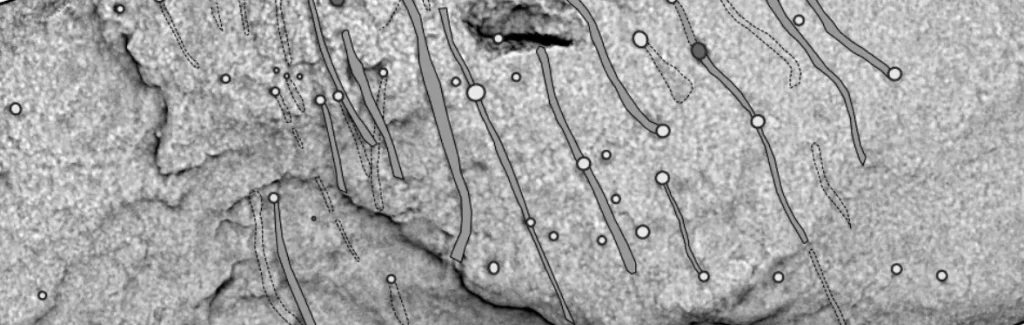
This is a globally rare specialism. Using high-resolution 3D data and a suite of digital surface filtering techniques — ambient occlusion, depth mapping, sky visibility, positive openness and more — Tom can reveal carved details invisible to the naked eye. He works with rock art teams, epigraphers, medievalists, classicists, and museum curators on prehistoric petroglyphs, early medieval inscribed stones, decorated monuments, and small artefacts. He can work with your existing 3D data or capture new data remotely or on-site.
Clients include Historic Environment Scotland, Historic England, and Cornwall Archaeological Unit with research as part of teams published in the Cambridge Archaeological Journal, Time & Mind, British Archaeology and many more.
Audio Restoration
Wax cylinder recordings, fragile acetate discs, degraded magnetic tape, dictation wire — if it’s a historic recording that’s hard to hear, Tom can help. He applies specialist noise reduction, click and crackle removal, and audio enhancement to make voices, music, and spoken word intelligible again. This service is used by archives, oral history projects, museums, and private collectors. Remote working means files can be sent from anywhere in the world.